EmploIA
A Multidimensional Psychological Model of Employability
Research Aim & Project overview
By modeling personality, motivational tendencies (BIS/BAS), mindfulness, and self-concept, EmploIA provides a nuanced, data-informed perspective on perceived employability.
This project was inspired by my original PhD study. I have explored the psychological roots of perceived employability in a fast-changing job market. Building on insights from my doctoral research, this new analysis shifts focus to individual difference variables not previously examined—specifically, mindfulness, self-concept, and the BIS/BAS motivational systems. These traits offer a deeper lens into how people perceive their labor market position and their career potential.
The ML model uncovers patterns relevant for career self-reflection, development, or even tailored coaching interventions.
Methodology
Data: The dataset includes 343 anonymized cases, originally collected during my PhD research via online questionnaires with standardized psychological instruments. While rooted in earlier work, this project uses a different set of five variables and applies alternative methods, including gradient boosting and other ML techniques, to get new insights.
Key constructs: GBM model is based on variables derived from validated psychological scales:
SD3 (Jones & Paulhus, 2014); DE (Brown & Ryan, 2003), SOSS (Flury & Ickes, 2007); BIS/BAS (Carver & White, 1994); Hexaco (Lee & Ashton, 2018); MAAS (Brown & Ryan, 2003).
Key insights
Metrics:
[1] “RMSE: 0.49”
R² = 0.28
MAE = 0.388
```{=html}
Feature Importance Plot
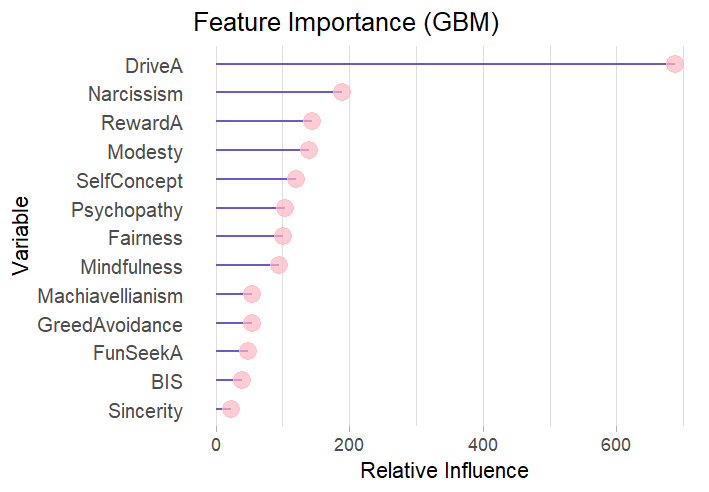
The interaction plots show the top features across employability. The highest level is spread across participants with a high level of drive and high narcissism. We can also see how important for employability is low modesty.
```{=html}
```{=html}
Tendency to follow own goals (drive) - is a key predictor of employability in young adults. There are other influential contributors: higher grandiose self-importance (narcissism), or lower callousness (trait psychopathy). Low modesty contribute to this.
These results reflect patterns specific to the research sample and should not be generalized to the broader population.