InerliAI
When Personality Shapes Psychological Energy
Research goal
Subjective vitality is a key indicator of well-being. This project applied both traditional statistical (EFA, regression) and machine learning methods (gradient boosting) to explore how individual differences predict subjective vitality.
This project explores the structure and predictors of subjective
vitality, including personality traits, basic psychological needs,
and self-determination.
It incorporates gradient boosting model (GBM), post-
stratification weighting, and is deployed as a live Shiny web
application for public exploration.
Methodology
Data: The dataset includes 586 working adults, collected via online snowball sampling using standardized psychological scales. Data were analyzed using SPSS, JASP, R. This document is a portfolio-specific report designed to showcase analytical skills and methodologies.
It is not intended for external distribution or academic publication.
Key constructs: GBM model is based on variables derived from
validated psychological scales:SD3 (Jones & Paulhus, 2014); MAAS (Brown &
Ryan, 2003), BPNSFS (Chen et al., 2015); PCASS
(Sheldon et al., 1996); Vitality (Ryan & Frederick,
1997).
Key insights
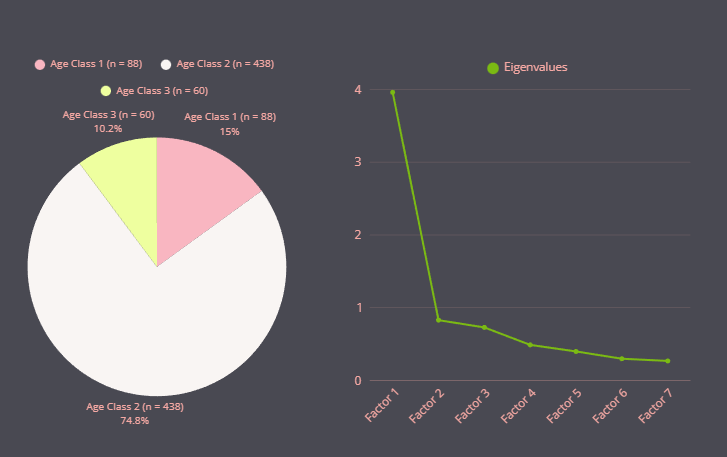
Exploratory Factor Analysis (EFA) confirmed the internal structure of the vitality scale. Post-stratification adjustments were applied to reflect variation across demographic groups. The predictive modeling phase used gradient boosting, which captured nonlinear and interaction effects among psychological variables. Model had reasonable accuracy.
rmse <- sqrt(mean((predictions - test_data$Vitality)^2))
print(paste(“RMSE:”, round(rmse, 2)))
[1] “RMSE: 0.9”
```{=html}
The findings highlight how subtle shifts in internal motivation and personality may shape our subjective experience of energy — insights with potential implications for coaching, well-being programs, and behavior design. Need satisfaction is a robust predictor of vitality across age groups and genders.
In particular, the fulfillment of the need to act autonomously and experience a sense of alignment between one’s actions and personal values emerged as the most influential contributor to psychological vitality among working adults.
```{=html}