RisxIA
Personality Patterns in Risk Behavior
Project overview
Why do some people flirt with danger while others prefer the safe route? What role does callousness & impulsivity (trait psychopathy) play in deliberate vs reckless risk-taking?
RisxiA explores how socially aversive personality trait (subclinical psychopathy), and risk behavior tendencies—can combine into distinctive psychological profiles/patterns. The tool allows users to explore how different combinations of traits might map onto these profiles — and reflect on the dynamics behind risky behavior.
Trained on anonymized psychological data and grounded in theory, the app uses K-means clustering to detect meaningful patterns.
Methodology
Data: The dataset comprises 300 cases collected through snowball sampling using standardized questionnaires. Data were analysed using R, SPSS and Shiny. This document is a portfolio-specific report designed to showcase analytical skills and methodologies. It is not intended for external distribution or academic publication.
Key constructs: Model is based on variables derived from validated psychological scales:
SD3 (Jones & Paulhus, 2014); DOSPERT (Blais & Weber, 2006).
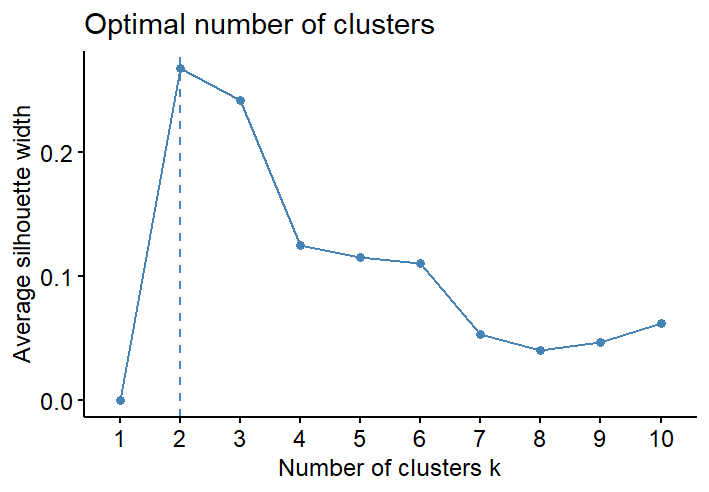
The model validation: I used multiple cluster validation techniques (silhouette width, within-cluster sum of squares, and gap statistic) to determine the optimal number of personality types, ensuring meaningful psychological structure rather than arbitrary groupings.
Key Insights
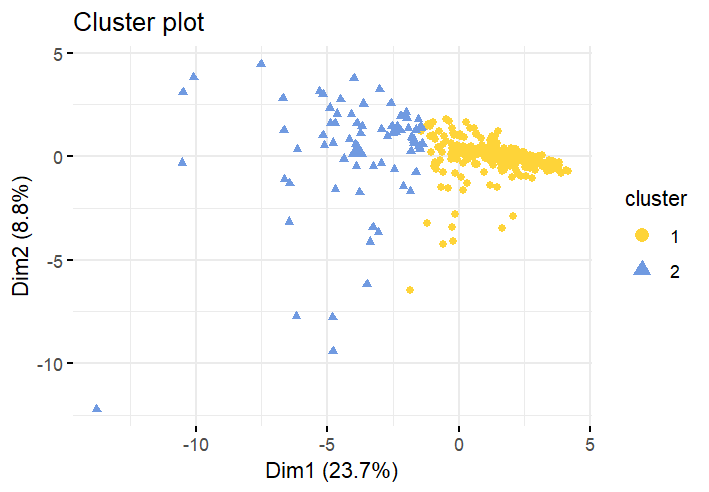
The plot shows how the data is grouped into two distinct clusters based on similarities in personality traits and risk taking tendencies. Each color represents a separate group.
```{=html}
APP
Cluster 1- Selective Risk Taker:This type is somewhat imbalanced, occasionally drawn to risky situations. While not prone to prominent impulsive or antisocial behavior, they may take risks in specific areas that feel personally meaningful, purposeful, or rewarding. Their overall risk profile is modest — but not entirely safe. Their willingness to take risks may stem from mild recklessness or impulsivity, or from contextual motivations such as curiosity, opportunity, or boredom. This type embodies deliberate, value-driven risk-taking, often (though not always) with an underlying effort at control and reflection.
Cluster 2- Adventurous Risk Taker: More impulsive than the Selective Risk Taker and more likely to disregard consequences. This type may challenge norms and take broad, unfiltered risks. They can be described as curious, independent, or spontaneous sensation-seekers. They tend to take risks, especially when something feels worth it. Although not extremely impulsive or callous, they may behave irresponsibly, push boundaries, and seek stimulation. Often driven by inner tension or the pursuit of novelty, they are drawn to growth, change, and fun — sometimes at the expense of caution.
Cluster 3 (synthetic)
Controlled Risk Averser
This profile reflects a generally low-risk orientation — but not total risk avoidance. People in this category tend to be thoughtful and selective about when and how they take chances. Their risk-taking is limited or modest across domains, suggesting they’re not driven by thrill-seeking or impulsivity. While they may engage in occasional or context-specific risks, these are likely measured, rare, or guided by strong personal values. Compared to the two machine-learned types, they lean more toward stability, caution, or control — but that doesn’t mean they’re entirely risk-averse or immune to spontaneity.
*Note: This profile was created as an interpretative reference for people who score in the lower trait range. It wasn’t directly derived from the machine learning model but serves as a benchmark for more grounded, self-regulated behavioral styles.